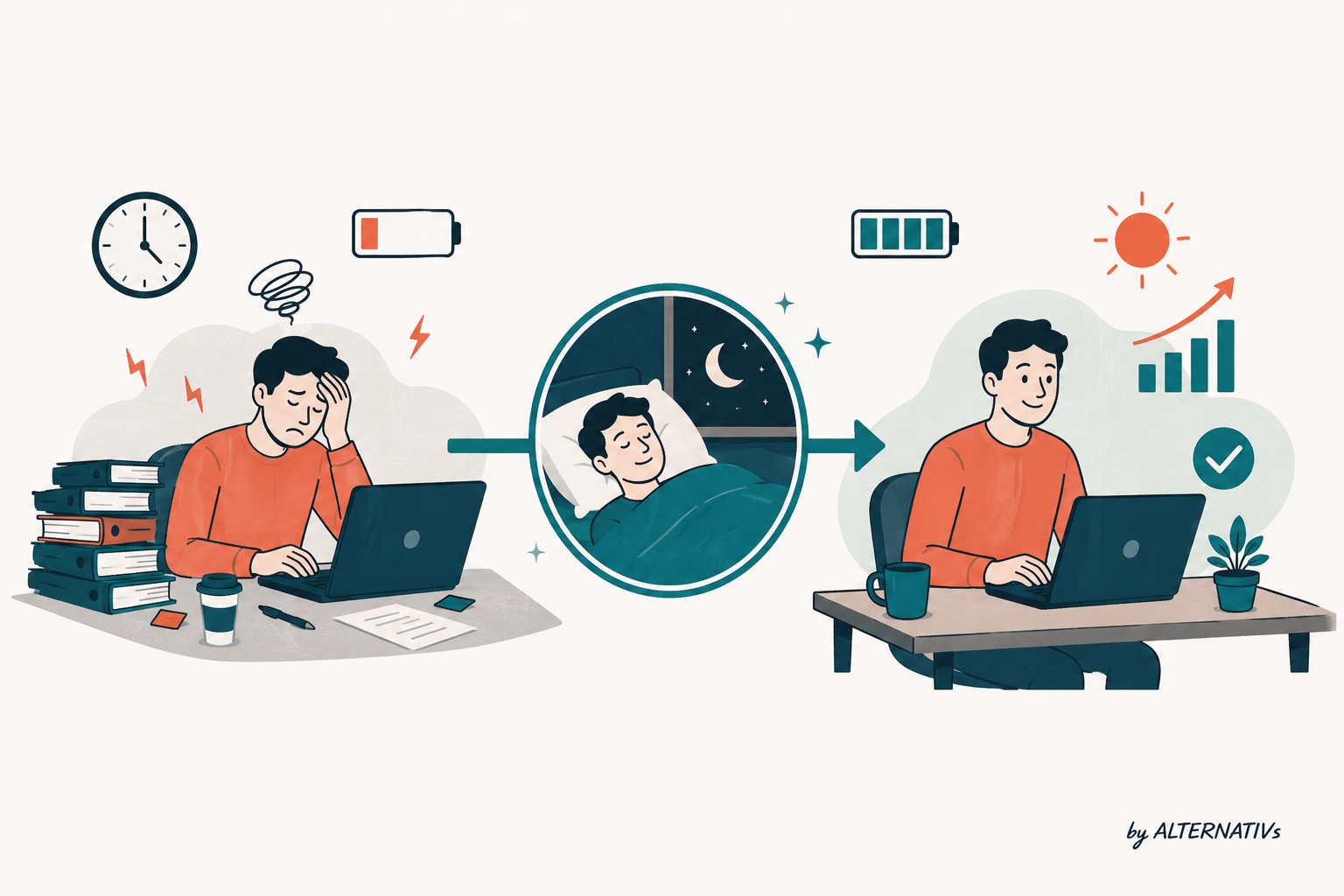

From all the things you can do to prevent burnout, perform at your best, be efficient in life and career, and recover from burnout, SLEEP is the ONE THING to start with. And you can start today!
There’s a moment many high-performing people know during their career. You wake up after seven hours in bed, technically “rested,” but still feeling off. You reread the same email three times, patience is thinner, and small decisions feel heavier than they should. You tell yourself it’s stress, workload, or simply adulthood.
In our experience, it always comes back to sleep.
Not only the amount of sleep you get, but also its quality. Does your rhythm follow the circadian rhythm? The way we sleep quietly shapes how we think, lead, communicate, recover, and move through the world.
We still tend to treat sleep as something flexible and negotiable. In many professional environments, exhaustion has almost become a symbol of ambition. If you are constantly tired, it must mean you are committed, driven, and productive. Rest is often framed as something we earn after the important work is done.
But biology does not care about workplace culture. Your body will react to sleep deprivation, and it will cost you in terms of health as well.
The human brain is not designed to function without restoration, and the effects of poor sleep are not felt immediately, which is also why it is ignored for so long. Cognitive performance starts to decline quietly before it collapses in what is seen as a loud boom, once someone goes on sick leave.
Research consistently shows that sleep deprivation affects attention, memory, emotional regulation, creativity, decision-making, and stress resilience. But most people do not experience these changes as isolated cognitive symptoms. They experience them as shorter patience, mental fog, bigger-than-intended emotional reactions than intended, and the feeling that they are no longer showing up as themselves.
In short, we not only feel tired when we lack sleep but also think, react, and relate to others differently.
A leader making decisions when they are sleep deprived is more likely to become impatient or reactive. A parent with poor sleep has less emotional space to hold their children emotionally, especially during a meltdown. Teams running on exhaustion communicate differently from rested teams. Sleep affects not only individual performance, but also the emotional climate we create around us.
And underneath all of this, the body is constantly trying to restore balance.
During healthy sleep, cortisol, the body’s primary stress hormone, naturally goes down. Melatonin helps regulate the body’s internal rhythm. Growth hormone supports physical repair and recovery. At the same time, the brain processes information, consolidates memory, and clears metabolic waste accumulated throughout the day.
Sleep is not passive.
Even while we are unconscious, the body is constantly working to restore and regulate itself, and most of that work happens invisibly.
When sleep becomes inconsistent or shortened, the nervous system struggles to fully recover. Cortisol stays high longer than it should. The body stays in a continuous state of stress. Poor sleep also affects the hormones linked to hunger, appetite, and stress, which is why exhaustion often changes not only how we think but also what we crave and how we respond emotionally to pressure.
And of course, sleep is not identical for everyone. Research increasingly shows that biological differences, stress levels, age, hormonal changes, and even gender can influence how much sleep a person truly needs. Some people may function relatively well on six hours at times, while others genuinely require more recovery time to think clearly and regulate emotions effectively. Women, in particular, often experience more sleep disruption throughout different hormonal phases of life, which can directly affect energy, cognition, and emotional resilience.
This is why chronic sleep deprivation affects far more than productivity. It affects perception, patience, emotional resilience, relationships, and presence.
And I’ve noticed something else over the years, especially as my body has changed and life has become fuller and more demanding. No matter how emotionally, mentally, or physically difficult a day might be, good sleep changes my capacity to meet it. The circumstances may not change, but my ability to respond to them does.
I think this is what many people misunderstand about rest. Sleep does not remove difficulty from our lives, but it does change the version of us that walks into it.
This feels especially important right now because we are living in systems that constantly interrupt recovery. Notifications follow us into bed. Work extends into evenings and weekends. Stress keeps the nervous system activated long after the day is over. Even rest has become something we try to optimize rather than genuinely experience.
And this is often the missing piece in conversations about performance. We focus heavily on output, goals, discipline, and resilience, while ignoring the biological conditions required to sustain them.
For years, I treated sleep as negotiable. One more email. One more project. One more late night because the work mattered. And for a while, I was still functioning. I could still deliver results and meet expectations.
But eventually I noticed that the quality of my presence had changed. I became more reactive, less patient, and less spacious in my thinking. My body was communicating something my mind kept trying to override.
That is the difficult thing about sleep deprivation. It rarely announces itself all at once. It slowly narrows your capacity before you even realize it.
What changed for me was not some extreme wellness routine or perfect morning ritual. I simply stopped seeing sleep as laziness or wasted time and started seeing it as part of caring for the system that carries my work, relationships, leadership, and life.
So maybe the better question is not, “How much can I achieve while exhausted?”
Maybe the better question is, “Who do I become when I’m properly rested?”
Sustainable performance is not built by constantly overriding the body. It is built by learning how to work with it.
And maybe real performance begins the moment we stop fighting the very systems meant to sustain us.
Read more about ALTERNATIVS, a holistic approach to performance, communication, and scaling up.
Until next time,
Leave a Reply