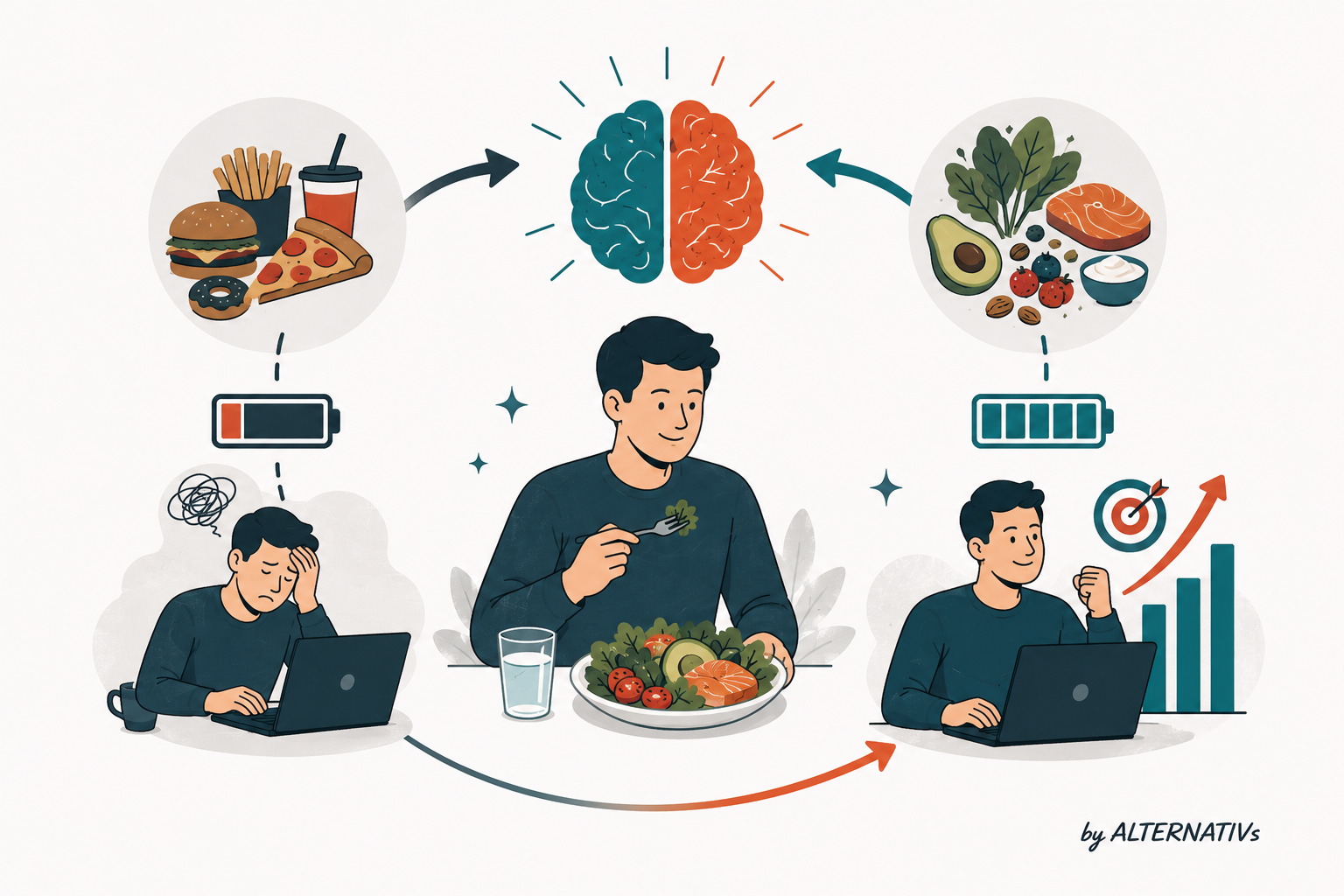

Think about the last time you hit a wall at 3 pm, the kind of where you’re staring at a screen, re-reading the same sentence, and your brain just refuses to cooperate.
You probably blamed the meeting before lunch, the bad night’s sleep, or the fact that it’s some days are just like that. The question that you should ask is: “What did I eat today?”
Because your brain – the organ running your entire professional life, your parenting, decisions, and your relationships — is built from and powered by food.
What your brain actually runs on
Your brain is about 2% of your body weight. It consumes roughly 20% of your daily energy and doesn’t take breaks. And unlike your muscles, it can’t store fuel, it needs a continuous, stable supply of glucose to function, along with a very specific cast of nutrients to produce the chemicals that make thinking, regulating emotions, and staying focused even possible.
The key players in brain’s health are omega-3 fatty acids (the structural material of neurons), B vitamins (essential for neurotransmitter synthesis), magnesium (the mineral your nervous system uses to stay calm under pressure), and tryptophan (the amino acid your brain converts into serotonin which is your mood stabilizer).
When those nutrients are in short supply, your brain looses its ability to function properly, so you feel it as fogy brain, lack of focus, and feel more irritable. You feel like your brain works at 70% and can’t quite explain why.
Hormones and Brain Performance
Food doesn’t just feed your brain, it also directly regulates your hormonal system. And your hormones are running a silent background program that determines your cognitive state all day long.
Cortisol – your stress hormone – follows a natural daily rhythm. It should be high in the morning (alertness, activation) and taper off by evening (rest, recovery). A diet high in refined sugars and ultra-processed foods disrupts this rhythm. Blood sugar spikes trigger cortisol spikes. Cortisol spikes impair the prefrontal cortex – the part of the brain responsible for rational thinking, impulse control, and nuanced decision-making.
For eample, the 11am pastry spikes your blood sugar, which spikes your cortisol level. Add a coffee next to it, and you force your body to release extra cortisol that is not needed. The cortisol that was just released degrades the quality of everything you think and decide for the next two hours.
On the other side, stable blood sugar keeps cortisol flat, which keeps your prefrontal cortex online, which keeps you sharp, measured, and regulated, even when the day gets hard. The goal here is to eat in a way that keep your blood sugar stable.
for tired parents with young children
If you’re raising children and working full-time, your hormonal environment is already under pressure. Chronic or mild sleep deprivation increase cortisol. Constant motional labour decrease serotonin, and the constant context-switching burns through dopamine faster than your brain can release.
Food is the one input in that system you can actually control most days.
And yet, when parents are most depleted – running on fumes, kids to school, back-to-back calls, and run back to take the children from school – they eat the worst. Fast carbs for quick energy, coffee instead of breakfast, and a sandwich over the keyboard at 1pm. In the evening on the other side, due to lack of dopamine and serotonine, self-control is lost and eating becomes a coping mechanism with life and a way to hide from the day that just pased.
These are patterns with biochemical consequences, and understanding the consequences is the first step to changing this pattern tat does not serve you or those around you. You need your barin to function well, and it all starts with your plate.
Backed up by research
A 2015 study published in the journal Nutritional Neuroscience found that diets high in saturated fat and sugar, were associated with significantly worse episodic memory and spatial learning. This the kinds of memory you use when you need to recall a conversation, keep context across a long project, or navigate a complex negotiation.
Conversely, diets rich in omega-3s (found in oily fish, walnuts, flaxseed), polyphenols (found in berries, dark chocolate, olive oil), and complex carbohydrates were associated with better attention regulation, reduced anxiety, and stronger working memory.
The gut-brain axis adds another layer worth considering when it comes to performance: roughly 90% of serotonin is produced in the gut, not in the brain. This means that what you eat directly shapes the gut microbiome that produces the neurotransmitters your brain depends on for mood stability and stress resilience. Your gut is not separate from your head, it is in fact part of the same system.
how to eat starting today
You don’t need a meal plan or a nutritionist, but you do need three small protocol changes that also compound fast, and produce in a relativelly short time, the resukt yoiu need to run a complex system, called life.
The first is to eat protein within 90 minutes of waking. Protein provides the amino acids – particularly tyrosine and tryptophan – that your brain uses to synthesise dopamine and serotonin. Starting the day with just coffee and toast means starting without the raw materials for your best thinking. Make surre you breackfast has eggs, Greek yogurt, a handful of nuts, at least 2 vegetables and an apple. Half your plate should be protein and half vegetables next to a tiny piece of bread or cracker.
The second is to build every work meal around protein, fiber and fat before carbohydrates. Eating fiber and healthy fat first (vegetables, legumes, olive oil), next to protein, before carbohydrates slows glucose absorption, flattens the blood sugar curve, and keeps cortisol from spiking mid-morning or mid-afternoon. This is one of the most evidence-backed and immediately actionable nutrition interventions available.
The third is to take hydration seriously. Your brain is roughly 75% water. A 1–2% drop in hydration impairs short-term memory and attention. Most people working long days in offices are mildly dehydrated by early afternoon without knowing it. A glass of water before each meal and a refillable bottle in view during work is enough to close most of that gap.
think about what’s on your plate
You are not eating for pleasure or for fuel in the litaral sense, even thou those are important parts of life and pleasure is needed as much as the fuel to have a good life. You are eating though to maintain the biological infrastructure of your performance – as a professional, as a parent, as a person who needs to show up reliably for others.
The cognitive labour you do every day is real, so is the hormonal cost of that load is real. Food is one of the few places where you can intervene directly, cheaply, and immediately.
Now, do. not go into the high performer mode and set up to do it perfect (I know how your mind works). Take it slow, and add one thing a day until your plate is a bit more intentional than yesterday.
What is one thing yiu can apply from this article staing today? Looking forward to hearing from you in the coments below, and share this information with frinds and family, so one by one, we become a healthier community who do life and work better than att the time tired. Rad more on healthy habits here.
Until next time,
Leave a Reply