
If you feel like all you do in your life latelly is to track things so you keep yoursef on track, we get you. You track your inbox that is overflowing with unred emails that keeps coming, your kids’ school schedules that keeps changing every week. You track your KPIs, your deadlines, your budget. But when was the last time you thought about your brain’s energy supply?
Not your motivation or your mindset. Your actual, biological, neurochemical energy – the stuff that determines whether you wake up with a sharp mind in the morning and do life with energy, or just… warm a chair.
Cognitive performance is not so much about habits and systems as it is biology. Like any other biological need in our body, this amazing machine we call brain, needs nourishment and movement. Moving your body is one of the most powerful leverages you have in improving brain activity and performance.
What happens in your brain when you exercise
When you exercise (even a 20-minute walk) your brain releases a protein called BDNF (Brain-Derived Neurotrophic Factor). Neuroscientists call it “Miracle-Gro for the brain.” It supports the growth of new neurons (a process called neurogenesis), strengthens connections between existing ones, and improves the speed at which your brain processes information.
In parallel, physical movement triggers the release of dopamine, serotonin, and norepinephrine – the same neurotransmitters that antidepressants try to regulate, as a direct, immediate response.
Translation: A run isn’t just good for your heart. It’s a chemical reset for your thinking, and fuel for your creativity.
The high performer trap
What happens to a lot of high performers and busy parents is that movement falls o
into optional category. Lack of time, energy or menatl space, pushes sport low on the priority list as something you do if you have time left over. If the kids are in bed, the project you work on (from home after the kids are in bed) isn’t on fire, and there is some energy left, than you sport. And we all know that mirracles like this doesn’t happen to often, isn’t it?
But the neuroscience shows solid evidence that sport improve exactly what busy people needs the most – cognitive capacity and mental energy to do it all. A 2018 study from the British Journal of Sports Medicine found that aerobic exercise before cognitively demanding tasks significantly improved performance on attention, memory, and executive function tests – the exact skills you need to lead a good meeting, make a hard call, or write a clear email.
When you skip movement to “have more time to work,” you’re often trading your best cognitive hours for more foggy ones.
You don’t need an hour at the gym
This is important for anyone running a full life. The threshold for cognitive benefit is lower than most people assume, and it is up to you to grow it’s capacity.
Research shows that even a single 10–20 minute bout of moderate aerobic exercise produces measurable improvements in working memory, processing speed, and sustained attention. These effects kick in fast – often within minutes of finishing – and last several hours.
What counts as sport is: a brisk walk, cycling to school drop-off, a 15-minute YouTube workout before your first meeting. What is important is that you develop a habit to move your body before you get a coffee, especially before a meeting. The coffee will trigger cortisol (teh stress ghormone), while moving your body will relsease good chemicals that will not only give you energy but also the inspiration and resourses to make good decissions.
Movement and stress regulation
There’s another layer worth talking abour, especially if your days run high on pressure, and endess demands.
Exercise lowers cortisol (your primary stress hormone) and recalibrates your nervous system’s stress response over time. People who move regularly don’t just have better moods, but they also have a wider window of tolerance. They can handle more before they become reactive, overwhelmed, or shut-down.
For anyone managing a demanding job and a family simultaneously, that window of tolerance is infrastructure for mental space and better energy management. In conclusion, sport should be part of your routine just liek you take your breackfast and strong coffee every morning.
A practical Guide
You don’t need a new identity into this sport mama or sport gyu. All you need it’s a small shift in the sequencing of your day. Reatranje your schedule a little so you fit the rocks first (the important things) before sand and water (the noisy and less important tasks) fill your cup.
Think of movement as preparation for the day, the same way charge your laptop before an importnat presentation so your laptop doesn’t shut down in the middle of the presentation. If you don’t expect your laptop to work without being charged regularly, you shouldn’t expect your best thinking from a brain that hasn’t moved (charged) in weeks or months.
Some realistic entry points for the overloaded working parent or high performer:
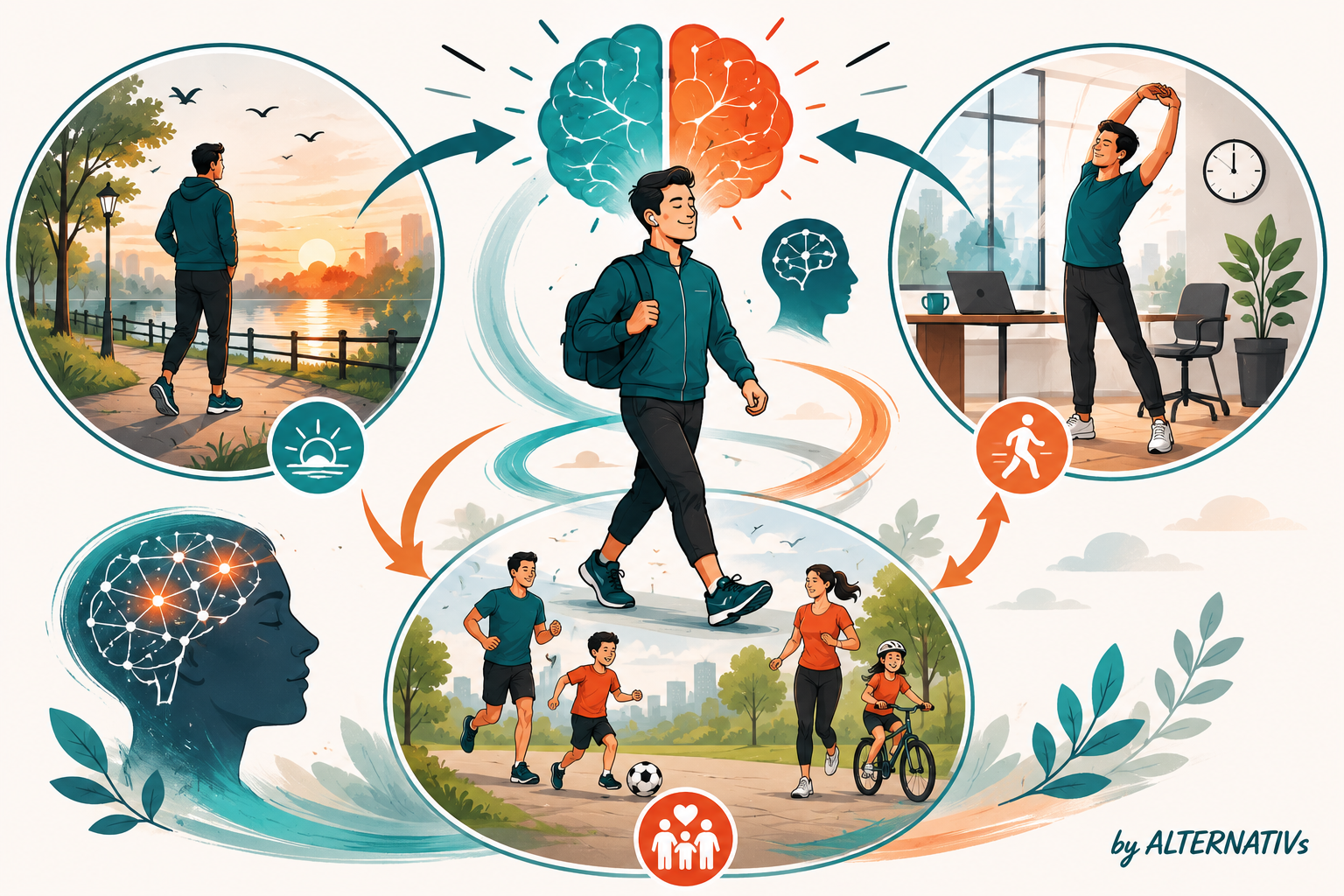
- A morning walk before the house wakes up, even 15 minutes, for mental priming.
- A movement break between deep work blocks – the research on attention fatigue shows that even 10 minutes of light movement restores focus more effectively than scrolling or coffee.
- Movement with your family – a walk, a bike ride, kicking a ball around. You’re not sacrificing family time, and you recharge your brain while being present.
The brain is not separate from the body, it is an integrated part of it. And like any high-performance system, it needs the right inputs to give you the output you expect from it.
More on healthy tips for holistic performance, communication and leadership, here.
Un til next time,
Leave a Reply